Timeframe: 2026
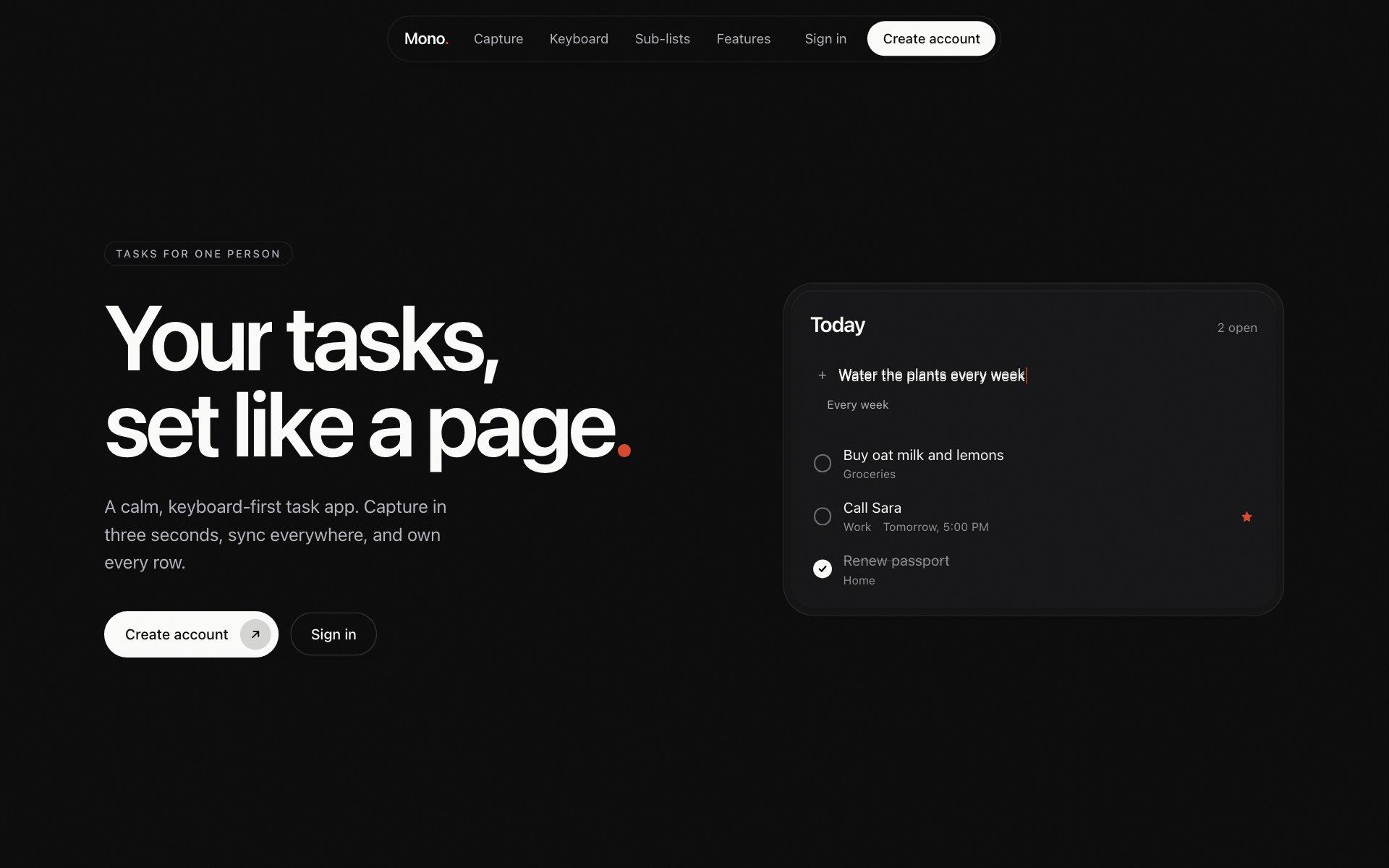
Context: I wanted a task manager with nothing extra in it, one that is fast and that my AI tools could use as well as I can. Mono is that app, and I now use it to run my own work and my team's at Bracken.
Problem / Goal: Build one task system that works the same on every device, keeps working offline, and is safe to share and to connect to an AI assistant.
My Contribution
- Data model: lists with one level of sub-lists, tasks with one level of subtasks, due dates, recurrence, stars, notes, and soft deletes
- Sharing: shared lists with roles and multiple assignees per task
- Security: Row Level Security on every table, covered by 56 pgTAP assertions; TOTP sign-in
- Shared core: an
@mono/corepackage (sync, ordering, dates, recurrence) and@mono/designtokens used by every client - Web (Next.js): the main app plus account management
- Desktop (Tauri): a keyboard-first three-pane layout with a global shortcut and auto-updates, at roughly a tenth of Electron's size
- Mobile (Expo / React Native, Android first): an offline SQLite mirror that syncs to Supabase
- MCP server with OAuth 2.1 and a consent screen, so Claude can list, create, update and complete tasks and lists
- A release page for desktop installers
Approach & Tech: Supabase (Postgres, Auth, RLS), TypeScript throughout, Next.js, Tauri with React, Expo / React Native with SQLite, Model Context Protocol, and append-only migrations.
Outcome / Impact: Mono runs at mono.majdb.com on web, desktop and Android, and connects to Claude as a native tool.
What I Learned:
- Putting authorization in the database (RLS) means every client, including an AI agent, gets the same guarantees
- One shared core package is what makes three very different clients behave the same way